Not a Review, Not a Survey Either
There's one thing you most want to hear from a customer, and no word quite fits it. Not a review, written for strangers. Not a survey, a form you had to build and beg people to fill out. The signal you actually trust is the regular who pulls you aside on the way out and quietly tells you the one thing. Here's why that private, unasked word beats every dashboard, and what it takes to finally make it scale.


You keep trying to name the one thing you actually want to hear from a customer. Every word you reach for is the wrong shape.
You say "it's kind of like a review," and the person across the table looks at you like you switched languages mid-sentence. So you try another word. That one's wrong too. Three weeks of this and you still don't have it.
Here's why. Reach for "review," and now it's public and permanent, and somebody had to decide to become the kind of person who writes one. Reach for "survey," and now it's a form you built, a thing you had to ask for. Reach for "feedback," and the whole thing suddenly sounds like a process with a login.
Each word files the thing under something it isn't. And the thing you're actually pointing at slips out from under every label.
Measure the tool, not the label
The problem isn't that you can't find the word. It's that each of those labels is a different-shaped container. And the container, not the customer, decides what you get to hear.
Take the three you already know: a review, an emailed questionnaire, a word passed over dinner. None of them is "customer feedback" in the plain sense. Each is a different biased slice, because the tool decides the truth you get. A review is written for strangers. A questionnaire answers the question you already thought to ask. Word of mouth never reaches you at all.
So stop trusting the branding on the tool. Measure the tool itself.
Measured, every channel a customer can use has three fixed settings. Whether anyone else can see it, public or private. Whether you had to ask, or they just offered. And who actually catches the message, you, or other customers, or a middleman in the gap between.
Those three settings decide the truth you get. Not the logo on the app. So walk the channels you know, and watch each one fail on a different setting.
Start with the stars
The public star channel, the one written for strangers, fails on the first setting: visibility.
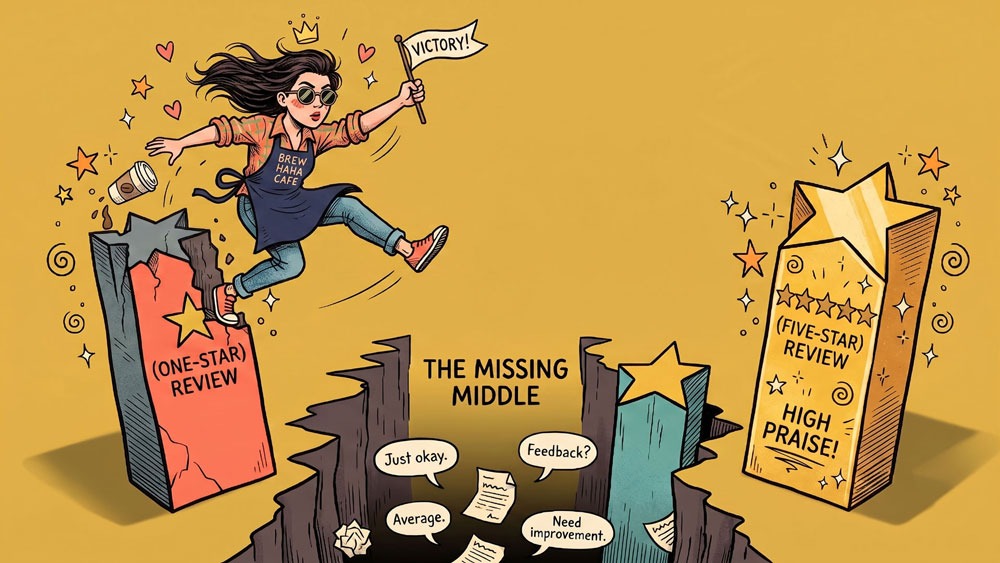
Visibility means an audience, and an audience makes people perform. Put a crowd in the room and people stop telling the truth and start managing how they look. The thrilled show up. The furious show up. The quiet middle stays home. The picture skews to the extremes, by design.
And that skew isn't a hunch. Plot the public stars and they come out in a J: a tall spike at five stars, a shorter spike at one, and a middle that sags in between. So the average sitting on the page isn't a census of what people thought. It's a biased estimator. Here's the proof it's about who chooses to speak. In a controlled study where everyone was required to write one, the curve came out roughly normal. The J is an artifact of who bothered.
And who bothers is almost nobody. In a 2016 study, about eight in ten people said they read the stars before a first visit. About one in ten said they nearly always write them. The regulars who love you every Tuesday for four years never type a word. The stranger who came once, on the night the kitchen was slammed and two servers had called out, leaves two stars. And now that's the permanent public document.
The tool even wants the verdict first. Open the app to say the one small thing you noticed, and before you've typed a word, it wants stars. A number. Right now. It's a courtroom where the judge says "guilty or not guilty," and you say "I'd like to describe the incident," and the judge says "stars first, then we'll hear the incident."
And set the skew aside entirely. That document was never addressed to you. It's written for strangers deciding where to eat, and it's routed to them. Not to you. You're reading someone else's mail.
The emailed questionnaire at least comes to you. That's a point in its favor. But it fails on the second setting: solicitation.
Solicitation means asking, and asking is a tax. Fewer people pay it every year. Telephone survey response fell from 36 percent in 1997 to 6 percent two decades later. You built a form to find out what people think, and building the form is its own quiet admission that you had to ask.
And once you're asking, three problems come baked in.
The form can only hear the question you already thought to script. If the real thing they noticed isn't on your list, you never see it.
It lands weeks after the meal, when nobody remembers what the soup tasted like.
And the moment a score rides on it, a bonus, a flagged bad night, whatever, it gets gamed.
You know the form. You open the email with one thing to say. The AC was blasting. That's it, one note, and you'd have been glad to leave it. Then the form starts. Score the ambiance, one to ten. Score your server's attentiveness. Score the plate presentation of your entree, as if you'd been judging the plate instead of eating off it. Forty-one questions in, buried at question thirty-seven, there's an "additional comments" box. Your one real note has been sitting in the waiting room the whole time, trying to get to the doctor, while you score the parking lot.
So you get answers to your questions. Not the thing they actually noticed.
And the number you get back doesn't do the job people think it does. The one loyalty score every boardroom trusts was put to the test across 21 companies and more than fifteen thousand interviews, and it couldn't predict growth. Couldn't. It explains almost none of what people actually spend. The figure on the slide isn't hearing your customers either.
One channel is finally both private and candid. Word of mouth. No audience to perform for, no form to fill out. The soup was off and they say so, plainly, over dinner. Candid. Specific. Real.
But they say it to their friends.
Watch what that one setting does. If your closest friend comes for dinner and the soup is off, they tell you quietly, and you fix it by Thursday. If a stranger comes for dinner and the soup is off, they smile and say "this was great, thank you," and they never come back, and six months later you find out you've been serving a soup nobody wanted. The privacy is what makes the honesty possible. And the honest word goes to everyone except the one person who could fix the soup.
There's a deeper reason it stays invisible to you, too. The people most likely to leave are the first ones out the door, quietly, without a word. The customer who'd hand you the single most useful thing you could hear is the one who just doesn't come back. You see the empty table. You never hear why.
So word of mouth is honest. And completely invisible to you.
Three settings, three eliminations. Public, out. Solicited, out. Routed away, out. What's left is one combination, and it looks empty: private, unforced, delivered straight to you.
Something already lives in that cell. And you trust it more than any dashboard you own.
It's the regular who pulls you aside on the way out. Not upset. Not making a thing of it. Just informing. "Love this place, I'm here twice a week. The morning guy makes the coffee exactly right. The afternoon coffee is a different story. Don't know what's happening in the afternoon, but wanted you to know."
Look at what that message is. Private, nobody in the room but the two of you. Unasked, they brought it to you. Straight to you, the one person who can fix it. Specific, it's the afternoon coffee, not "three stars." And it comes from someone invested enough to be back Thursday.
A regular isn't there to make a thing of it. They want you to know, which is a different act entirely. A three-star verdict is a conclusion with no evidence. The regular hands you evidence with no conclusion, and you fill in the conclusion yourself, because you're the one who's actually standing there.
So the thing you couldn't name isn't new or exotic. It's the oldest, best signal you already know. It's the regular's quiet word.
But it doesn't scale
That quiet word doesn't scale, because it lives in your presence.
It needs you standing there. Known, trusted, at the exact moment the thought lands. The regular says it because they know you, and you're right there to say it to.
Take the presence away and the word goes with it. Grow past a certain size and you're not at the door anymore. Or just step into the back for an hour. Either way, the highest-signal thing you get evaporates in the parking lot.
You've watched it happen from the other side. You leave a place, and halfway to your car you have a thought. A small one. The music was a little loud at table four. You hold it for a second. You glance back at the door. And what are you going to do, walk back in and flag someone down? "Excuse me, I have a note." So you get in the car, and the thought dissolves into the parking lot. Meanwhile the owner is inside, genuinely trying to work out why table four has a strange vibe, and they will never learn it was one speaker pointed straight at it.
So the best signal you get is the one thing you can't be there for every time.
Three hundred years old
Here's the part that should reassure you. That private word handed straight to you isn't a startup invention. It's three hundred years old.
In 1721, a shogun in Japan set a locked box outside his council and let anyone drop a note in. The detail that matters: it was carried to him still locked, so nobody in between could open it, soften it, or lose it. Real reforms came out of that box. Fire brigades for a city that kept burning. A public hospital. Private, direct, unasked, straight to the top. Three centuries ago.
So the idea is old. The suggestion box that came after it, the one bolted to the wall by the door, didn't die because the idea was wrong. It died on follow-through. You drop a note in the slot. You hear nothing back. You watch nothing change. And after a while, only the angriest people bother to write anything at all.
The channel was right. The follow-through was what failed.
Which tells you something about the thing you've been trying to name for three weeks. It was never missing because the idea was wrong. Every version of it either died on follow-through, like the box on the wall, or never scaled past your own presence, like the regular's word. The category was never the problem. The operations were.
So fix the operations. Give every customer the easy, private way to do what your best regular already does without being asked. Then actually answer them. Close the loop the suggestion box never closed. And you finally hear the thing that was there the whole time.
First to know, instead of last.
You already know what the best thing a customer ever tells you sounds like. It's the regular who leans in on the way out and tells you the one thing, without being asked. All that was ever missing is an easy, private way for everyone to do it. And someone on the other end who actually listens.