Private By Default, Public By Exception
A customer had a thought about your place on Tuesday. You found out on Saturday, in public, from a stranger who left no name and takes no questions. Here is the thing nobody tells you: that public one-star was almost never a first move. It was a second one. The private door was just never built. Build it, and you stop being the last to know.


A customer had a thought about your place on Tuesday. You found out on Saturday.
You did not find out from her. You found out from a public one-star, written to strangers, with no name attached and no way to answer the person who wrote it. She sat in her car in your parking lot and typed a paragraph about you, for people who were not there and cannot warm the eggs, and then she drove off. You were the last to know. In public. About a thing you could have fixed in one sentence, if anyone had told you while she was still standing twenty feet away.
By eleven-thirty that night it is on your phone, and the worst of it is not the one star. It is the return address. There isn't one. She signed off as DiningInquisitor88, and DiningInquisitor88 is not taking questions.
And so you assume.
You assume this is just how customers are now. They reach for the megaphone first. Offered the choice between saying it to your face and performing it for a crowd of strangers, they pick the crowd every time. They would rather write you up than talk to you.
But is that actually true? Why did telling a thousand strangers become the easy thing, and telling the one person standing right there, the one person who could actually fix it, become the hard thing? When did that flip?
It is not true. It is not who customers are.
Ask them and they say the opposite. When people are asked how they want to reach a business, they say privately. One to one. A direct word, not a public one. Nobody wakes up wanting to post about you. They want to reach you.
So why the public post? Because in the moment, the public post is the only door that is open. It is one tap. It is always there. It has been waiting. At the exact second the reaction happens, the public path is sitting right there in a familiar app, while the private path means hunting. A number somewhere. A form somewhere. A person who may or may not be around. Some door that usually is not built at all. So the public post is not desire. It is availability. It is the thing that happened to be easy at the moment it mattered.
Which means the default was designed. It was not chosen, and it was not chosen by you.
Here is the uncomfortable part. There is no neutral way to arrange a choice. Whenever two paths sit in front of a person, whoever made one path one tap and left the other one effortful has already decided which path most people will take. Not by forcing them. By making one easy and the other a chore. That is the whole game.
And this is not a soft effect. It is one of the most reliable things behavioral science has ever measured. Flip the default and behavior follows, even against what people swear they want, even against active persuasion. Organ donation is the classic case. Ask people to opt in and about 42 percent agree to donate. Ask them to opt out, same single click either way, and about 82 percent stay in. Same people. Same form. Double the donors. Retirement savings tells the same story. Auto-enroll people instead of asking them to sign up, and participation jumps from around 37 percent to around 86 percent, and nothing about the money changed. Nothing changed but which option was the easy one.
Somebody already designed where your customers take their thoughts. Somebody made the public post the one-tap move and left the private word as the hunt. That design is doing the work. It just wasn't you.
So a public star usually is not a first move at all. It is step two.
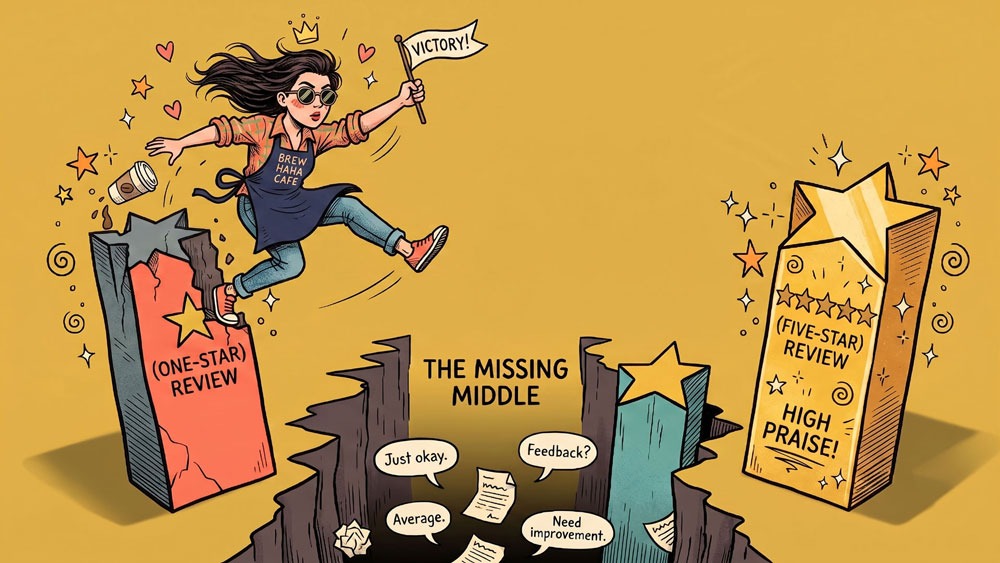
Read it again with that in mind. The one-star is what a customer reaches for when the private path did not exist, or existed and never answered. It is a fix-request that went looking for a door and could not find one.
One out of five. From it, the owner learns exactly two things: something happened, and it was bad. Not which table. Not which night. Not which moment. A verdict, and no trial.
The friction is on the wrong path. Going public is three taps and a star. Going direct is the long way around.
And here is what happens when the direct word never lands. Nearly half of public posts get no answer at all. Forty-three percent, in the most recent national numbers, hit pure silence. That silence is the exact thing that hardens a fixable moment into a permanent one. A thing that could have been settled in thirty seconds becomes a public record, because the one person who could have settled it never got the chance, or got it and said nothing.
There is no single clean number for how many public stars started as a private word that failed. But you do not need one. You have two motives that send people public: warning others, and being heard. You have a private path that usually is not built. And you have nearly half of public posts hitting silence. Put those together and the shape is obvious. A lot of what looks like a first move is a second one.
And once you see it that way, you notice something. Everyone serious already runs the opposite default.
Look at security researchers. Someone finds a flaw in a company's system, and the accepted rule is not to blast it to the world. It is to tell the company privately first, hand them a fixed window to patch it, and go public only if they are ignored or the clock runs out. CERT sets that window at 45 days. Google's Project Zero gives 90. Private first, public backstop. It is the cleanest statement of this whole idea anywhere, and it comes from the most adversarial corner of the internet.
Whistleblower law does the same. It rewards you for raising the concern inside first and shields the public route only under stricter conditions. And the government tells ordinary customers the same thing. Official consumer guidance is one line: contact the business first, before you seek help anywhere else.
So there is your answer. The reason public comes first is not human nature. It is friction. And it runs backwards from every field that has ever actually thought the problem through. The hackers get a private door. The whistleblowers get a private door. The small-claims process makes you send a letter first. The most adversarial people in every one of these systems are handed private-first as the norm. Your happiest regular, the one who noticed something small and would have mentioned it in passing, does not even get the option.
So the fix is not to fight the public star. It is not to guilt anyone into silence, and it is not to abolish going public at all, because public stars genuinely reward good independent businesses. That part is real.
The fix is to build the private path until it is the easy one. Make the direct word the one-tap move. Let public be what it was always supposed to be. The escalation. The thing that gets earned only when the direct word was never offered or never answered.
And build it honestly, because one version of this is flatly illegal, and the line is worth stating exactly. The crime is not privacy. The crime is selectivity. You may not screen customers for mood first, waving the happy ones toward the public post and quietly steering the unhappy ones into a private form so their words never reach the public record. That specific move, the happiness pre-screen, is what the FTC and the big public-post sites forbid, and companies have paid real money for it. Fashion Nova paid $4.2 million for quietly hiding the stars that came in under four. So the direct door has to open the same for everyone. Every customer gets the private path, offered equally, never triggered by how happy they seem. Offer it to all of them, or you are not doing this. You are doing the illegal thing that looks like this.
Get that right and the whole thing turns over.
Private by default, public by exception. You stop being the last to know. The fixable things get fixed quietly, where they belong, without anyone having to be asked twice. And the public record finally means something, because the only things that reach it are the ones that were never answered. A public star stops being an ambush and becomes a verdict that was actually earned.
The public star was never your customer's first choice. It was their only move. Give them a better one, and you stop finding out from strangers.
A customer has a thought about your place on Tuesday. You find out on Tuesday.