The Customer Voice Spectrum
You think the star page and the one person who spoke up on their way out tell you how the business is doing. They don't. The customers who decide whether you make it are the quiet ones you never hear from, the ones who ate the wrong order in silence and told eleven friends why. Here is who is really in the room, why silence is never satisfaction, and the one move that turns the quiet many into a voice you can finally read.


You think you have a decent read on your customers.
You open the star page in the morning and see what came in overnight. You catch the one person who says something on their way out the door. You put those two things together, and that becomes your picture of how the business is doing. It feels like enough to go on. It feels like paying attention.
It isn't. That picture is built from a tiny sliver of the room, and the sliver picked itself.
That self-selection is the iceberg, and the iceberg is the whole thing. For a small purchase, the vast majority of unhappy customers never say a single word to you. Only a handful ever take it past the person at the counter. Fifty years of research all lands in the same place: the people you hear from are not the many. They are the few who decided to speak.
So who are the rest? And what are they doing instead of telling you?
Start at the two ends of the room, because both ends lie to you.
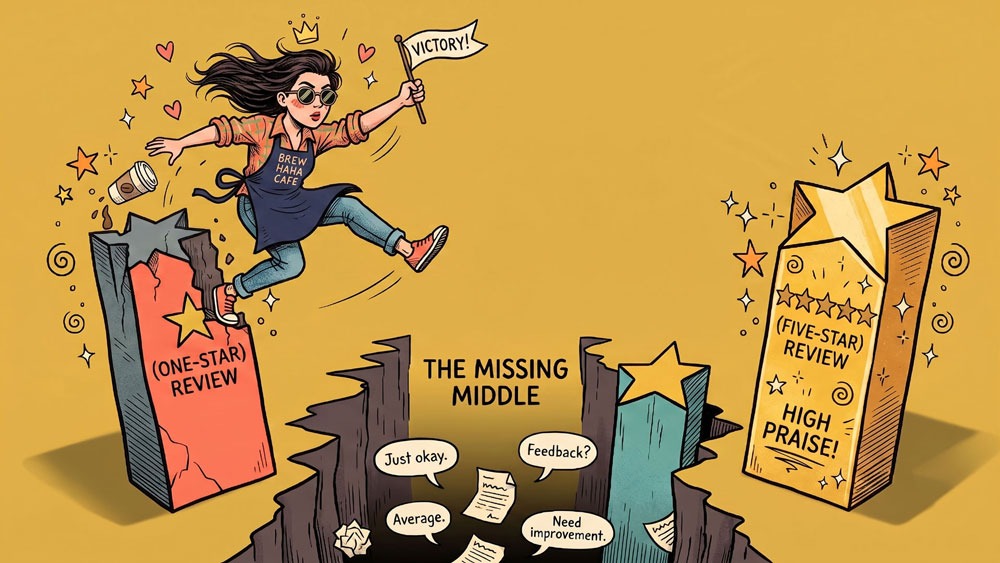
At one end sits the loud few. The ones who write everything down. You know the type. The customer who pulls out a real paper notebook before the food is even ordered, quietly scoring the ambiance of a sandwich counter that has never once thought about its ambiance. The trouble isn't that they're wrong. It's that they cluster at the extremes, the delighted and the furious, with almost nobody in the middle. Researchers who mapped online stars found the same lopsided shape everywhere: a pile of five stars, a spike of one stars, a hollow middle. And when they ran the experiment the other way, forcing everyone to weigh in, the same product came out looking roughly average. So the shape isn't the quality of your food. It's the personality of whoever chose to grab a pen. Your star average isn't a headcount. It's a funhouse mirror.
At the other end sits the silent endurer. The one who gets the wrong order, watches it land, feels the small flicker of recognition cross their own face, and then puts the fork down and eats it anyway. You swing by. You ask how everything is. They look right at you and say, "Really great. Thank you." Not "great, but this isn't what I ordered." Just: really great. Like the word "actually" was taken out of them before they were old enough to remember it.
They smile. They mean the smile. And you are never going to see them again.
Here is the part that should stop you.
The most powerful band in the room is at neither end. It's dead center. And it's completely invisible to you.
These are the word-of-mouth people. They will never post a public word about anywhere they have ever been. But they talked to eleven people about your place last Thursday. At a kitchen table. In a group text that hasn't gone quiet in a decade. In a parking lot at school pickup. The overwhelming majority of the talk about your business never touches a screen you can see. The research that pinned this down is a little older now, from before the social-media surge, but it was blunt about it: only about seven percent of word of mouth happens online. The rest lives in the air, in rooms you will never be in.
And that talk is your reputation. Not the star page. The talk.
Picture Diane. She doesn't write things down. She's on two neighborhood groups, a text thread, and a standing dinner with a sister-in-law who asks her where to eat every single time. Somebody says "Italian?" and Diane sets down her fork and goes to work. Get there before seven. Get the gnocchi. Ask if Paula's on. Skip the orange juice, it's from a carton. She sent you eleven people this month and quietly steered one away over that orange juice, and you will never know she exists. You cannot thank her. You cannot fix a thing she has strong and permanent opinions about that reached you never.
Because you're never in those rooms, the most dangerous instinct an owner has kicks in.
No news must mean everybody's happy.
It doesn't. Silence is not satisfaction. Silence is a data vacuum, and for a local business it usually means they left quietly and told a few friends why on the way out. Nancy Stephens, who studies this at Arizona State, says it flat: managers should not mistake silence for satisfaction. Most unhappy customers never say a word. They just take their business elsewhere.
She turned up an Idaho campground owner who bragged, to one of the researchers, that only four guests had ever said a word against the place in thirteen years. He thought that was the scoreboard. It was a smoke detector with the battery pulled out.
And the stakes are not soft. A Harvard study of independent restaurants found that one more star on your Yelp page is worth five to nine percent more revenue, a jump the chains barely feel. For a place with your name on the door, reputation isn't atmosphere. It's revenue.
So put it together, and the conclusion is uncomfortable.
The star page you refresh every morning is the least representative thing about your business. And the customers who most decide whether you make it are the ones you have never heard a single word from. You've been reading the wrong page this whole time.
You're not powerless. The fix just isn't the one owners reach for.
You can't find Diane. You can't market to the middle. You can't argue a star average into telling the truth. What you can change is the one thing every study on this agrees on: being asked turns silence into voice. Lower the cost of telling you to almost nothing. Make it quick. Make it low-stakes. Take away the public stage that nobody in the quiet middle ever wanted in the first place. Do that, and the silent majority will actually tell you something.
That's the whole move. Stop watching the loud few. Make it effortless for the quiet many.
Because the realest thing your customers ever tell you was never typed onto any page. It's whether they walk back through your door.
Right now, the quietest people in your room are writing that verdict every single day. The wrong order they ate in silence. The orange juice they'll mention to everyone but you. The return trip they will or won't make.
Make it easy for them to say something first. Otherwise you'll only ever read the verdict in the empty tables.