Unsolicited Feedback Is Worth More
A customer with her coat on, three steps from the door, turns back to say the bread was warm. That one sentence beats your whole survey. The 4.6 you trust is built by the act of asking, and it buries what was actually on her mind. Here is why the words nobody asked for are the ones worth trusting, and how to make them arrive on their own.


She has her coat on. Her purse is already up on her shoulder, and she is three steps from the door, done, out, mentally in her car. Then she stops. She turns back at the host stand and says one thing.
"The bread was warm."
That's all. Then she leaves.
That sentence is worth more than your entire survey. Here's why. And here's the one thing you get wrong every time you try to find out what people really think of your place.
You lean on the number.
You have a number. Most owners do. The 4.6. The star average. The "how was everything?" you toss out at the register while they're still counting their change. The email that lands in the inbox before they've even backed the car out of the lot.
It feels like knowing. It feels like you have a handle on what people think of your place, because there's a figure, and the figure ticked up a little this quarter, and you can put it in a slide.
But that number isn't what you think it is.
The asking builds the answer.
Here's the thing nobody tells you about a survey. The answer a form gets back is partly built by the act of asking. It isn't just reported to you. Some of it gets manufactured on the spot, by the question itself.
There's a famous study on this. Loftus and Palmer, 1974. They showed people footage of a car crash and asked how fast the cars were going. For one group they used the word "smashed." For another group, same footage, they used "contacted." The "smashed" group guessed 40.8 mph. The "contacted" group guessed 31.8. Same crash. One verb. Nine miles an hour of difference.
And a week later, the "smashed" group were more than twice as likely to "remember" broken glass in the footage. Thirty-two percent of them, against fourteen. There was no broken glass. The word put it there.
That's what a leading word does to a memory. Now think about every scale you send out. "How satisfied were you with our excellent service?" Every one of them is doing a quieter version of the same thing to your customers. The wording, the order of the questions, the scale you offer, all of it bends the answer before it ever reaches you.
So if the question is shaping the answer, what is your 4.6 actually measuring? And where did the honest signal go?
Asking doesn't bend the answer. It overwrites it.
It gets worse than bending. Asking doesn't just tilt the answer a few degrees. It paves over what was genuinely on the customer's mind and lays down your agenda instead.
You can measure that. Schuman and Scott, 1987, asked people to name the most important event of the past half century. When they had to volunteer it themselves, open-ended, about 1% named the invention of the computer. Hand them that same event on a list and about 30% picked it. Same topic. One prompt. A thirty-fold swing. The list didn't measure what mattered to people. It manufactured it.
Your survey does the same thing. "Did our staff make you feel welcome?" Before you asked, the customer wasn't thinking about welcome. They were thinking about whether they wanted the salmon. You introduced the concept, and now they're scoring it. Meanwhile the thing that was actually on their mind, the guy at the register who called them "bud" twice and then "boss" on the way out, the soup running a little salty, never had a box to go in.
And when they do fill in one of your boxes, they round up. A person standing right there tugs the score upward. In a controlled trial, patients gave a satisfaction score of 72.0 to an interviewer over the phone, but 68.9 on an anonymous web form. Same instrument. Only the mode changed. The authors put it plainly: people were "more reluctant to provide low scores to an interviewer." Nobody wants to be the one who hands a low score to a human being who's looking right at them.
Then there's the one number owners are told to chase above all the rest, and it keeps the least of its promises. Net Promoter Score, the "would you recommend us" figure, gets sold as the metric that predicts growth. But researchers who ran it across 21 firms and more than 15,500 interviews found it predicts revenue growth no better than plain old satisfaction does. The one number you were told you needed. And it tells you nothing the old number didn't.
Stack all of that up and your 4.6 reads high and flat. By design. Positivity, the wish to be agreeable, people clicking through on their way out, the unhappy ones who mostly didn't bother to answer at all. Every bit of it pushes the number up and squeezes out the middle. The number isn't lying on purpose. It just isn't the thing you thought it was.
The signal worth trusting is the one nobody asked for.
So where's the honest signal? It's the one nobody prompted.
When a customer volunteers a thought on their own, that thought already cleared a bar the form never sets. It was worth saying without being asked. They could have walked out clean, said nothing, been perfectly fine. Instead they decided you needed to know. That's a real threshold, and crossing it means the thought was genuinely there. Top of mind. Real.
That isn't just softer and truer. It's money. Michael Luca studied Yelp and independent restaurants and found that a one-star increase in the volunteered rating leads to a 5 to 9 percent increase in revenue. And here's the part that matters for you specifically. The effect showed up only for the independents. Not the chains. The thing customers tell you without being asked is the thing that moves independent revenue. Yours.
But the channel you just fell in love with is biased too.
Now, before you torch the survey and frame the reviews on the wall, hold on. The channel you just fell in love with is biased too. Honestly biased, but biased.
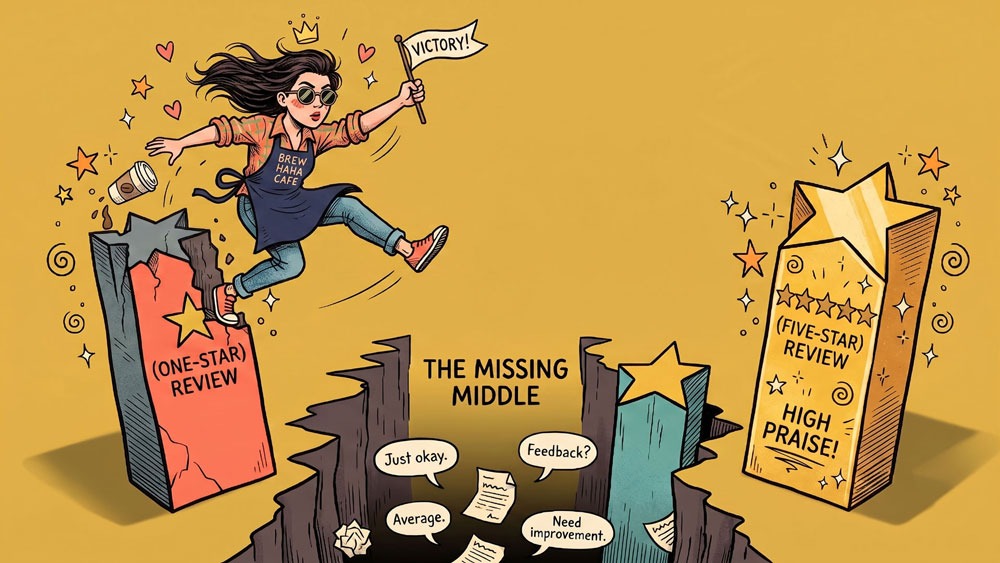
Here's the problem. Who actually volunteers a thought? The loud delighted and the loud furious. The person having a transformative experience, good or bad, right now. The quiet middle, the one who thought it was fine, the soup was okay, the parking was worse than expected, that person went home. They're living their life. They're not writing anything down.
You can see it in the data. Online ratings pile up in a J-shape, way too many fives and ones and almost nothing in between. Roughly 95% of Airbnb stays land at 4.5 stars or higher, in a paper literally titled "Where Every Stay Is Above Average." When nearly everything is above average, the rating tells two places apart about as well as a coin flip.
So what people volunteer is rich and real. But it is not a headcount. It tells you what was vivid, not how common. Read a pile of volunteered thoughts as if it were a representative census of all your customers, and you're reading it wrong.
So the fight was never surveys versus reviews. It was friction.
Which means the fight you thought you were in, the one where you have to pick a side, surveys or reviews, was the wrong fight the whole time.
The real problem underneath both is friction. The honest thought that never reaches you isn't trapped behind a better questionnaire. It's trapped behind the effort of speaking up. The quiet middle didn't hold back because your survey was badly worded. They held back because saying something took more effort than walking out the door.
So make it effortless to volunteer one real thought, and you get both things at once. You get the salience, the thing that was actually top of mind, because they chose the topic. And you pull the quiet middle back in, because now saying something costs almost nothing.
There's evidence this works. Brandes, Godes and Mayzlin, 2022. A simple, light, unpushy request for a review did not inflate the extremes. It pulled the moderate people back into the pool and de-biased the pile. The low-friction ask keeps the salience of the volunteered thought and fixes the self-selection at the same time. You don't have to choose.
The honest signal was never trapped behind a smarter set of questions. It was trapped behind the effort of speaking up. Lower the effort, and the truth arrives on its own.
The most valuable thing they almost didn't say.
The most valuable thing a customer will ever tell you is the thing they almost kept to themselves.
The bread was warm. The soup was too salty. The register guy called me boss. That's a report from the interior of a real person, about something that actually happened to them. You will not get it out of anyone with fifteen questions and a scale. There's no box on the form the shape of that sentence.
You get it one way. By making the moment they'd say it, without being asked, as easy as turning back at the door.
She had her coat on. She was already leaving. The only thing standing between you and the truest thing she knows about your place was the effort of turning around. Make that effort disappear, and she'll tell you.
Without being asked.