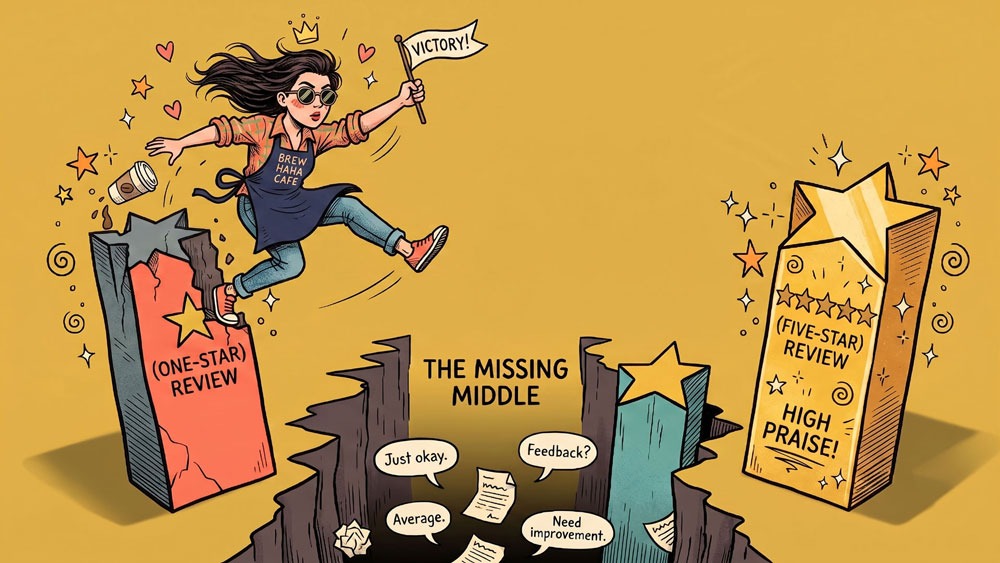
You're Not Flying Blind. There's Nothing to See.
The cruise guest who smiled and said "great" wasn't being polite. They were being rational. They're never coming back, so the honest answer costs them an awkward moment and buys them nothing. Here's why the one window where the truth actually exists closes the second they walk out, and why every road to it after that, the late one-star, the cruise line's list, is already a dead end.

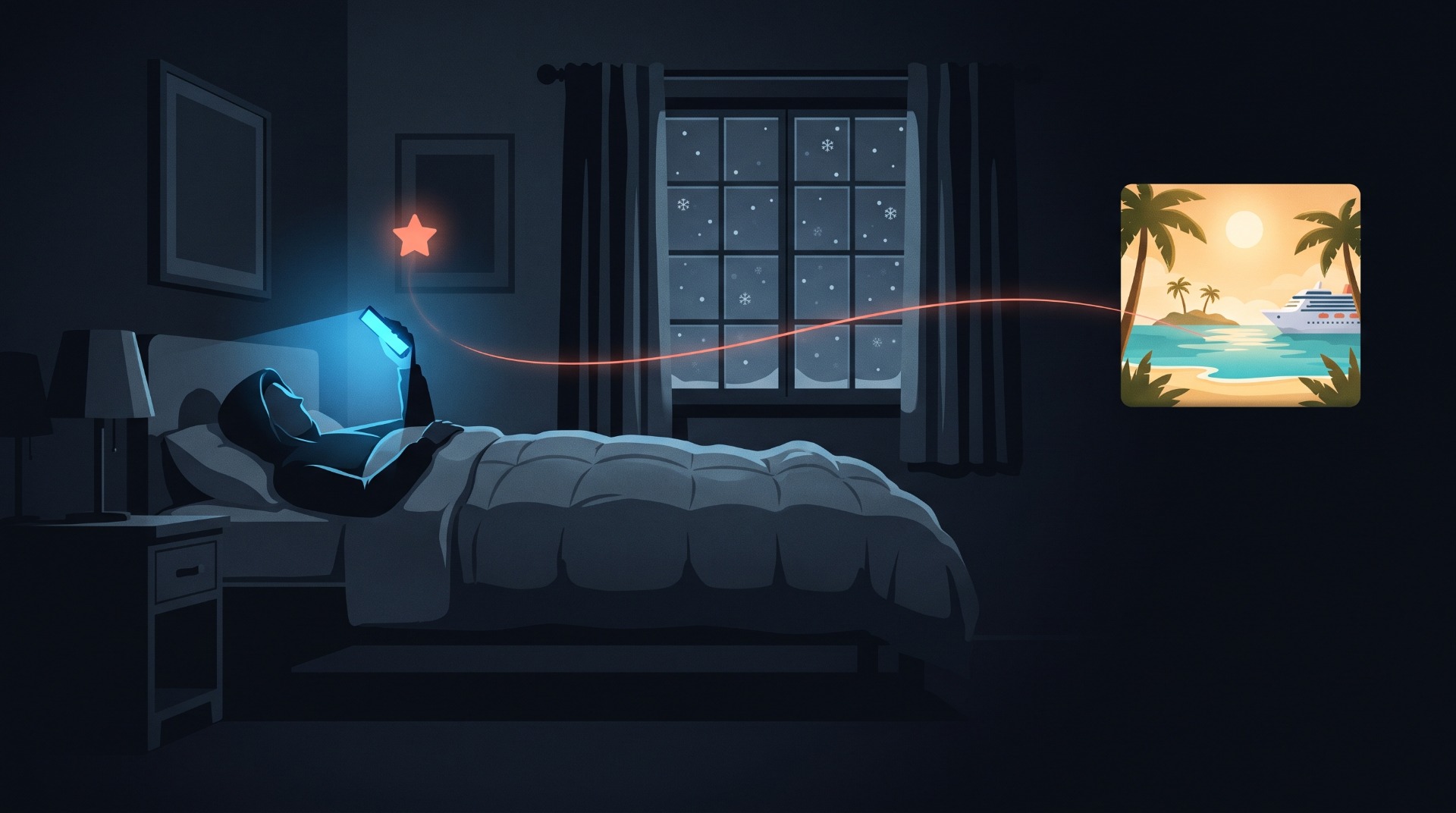
A couple walks in off a ship. They sit down. They order. And something is a little off. Maybe the AC is broken. Maybe the wait is long. Maybe the fish is dry. Something. You come out of the kitchen with a big smile and ask the question you always ask. "How's everything? We doing okay?" They look right at you and they say "great." Really good. Thank you so much. And you believe them. Why wouldn't you. They smiled. They said great. You go back to the kitchen thinking tonight went well.
But you have no idea what they actually thought. And you're about to see why you may never find out.
That "great" wasn't manners. It wasn't a fluke either. In the half-second before they answered, they did a piece of math. They are never coming back to this island. The boat leaves in a few hours. This person in the apron has nothing left to offer them. So telling the truth has no payoff. None. The honest answer costs them an awkward moment and buys them nothing. The polite answer ends the conversation and hands them back their vacation. So they gave you the polite answer. Which means silence isn't the exception with this customer. It's the rational default. And there are a lot of them. Roughly 1.7 million cruise passengers came through the USVI in 2024, across 533 ship calls, something like 141,680 a month with the crush from November to January. That's 1.7 million one-time encounters, and not one of them owes you a word.
Here's the part that should take the sting out. It isn't even about you. Tourism researchers built a whole framework for exactly this customer, and gave it a name: the Tourist Complaint Constraints. There's a peer-reviewed paper on why the nice couple lied to you. It maps the specific reasons a visitor won't say a word. They're rushed. They don't know how things work here, so they can't tell what's normal to flag and what isn't. There's no easy way to say the thing even if they wanted to. They've got nothing personally at stake in whether you fix it. And they're guarding the mood of a vacation they saved all year for. Strip the academic language off the two the research ranks strongest, and they say two plain things. They couldn't easily tell you. And they didn't know what was even normal to flag here. None of it is a verdict on your food. It's a verdict on the spot they were standing in.
Compare that to a regular. A regular would eventually tell you. It takes forever. Months, honestly. Somebody comes in every week, the soup is never quite hot enough, and they sit on it for a long time, because the relationship earns the one awkward sentence. By visit eleven, visit twenty, something in them finally gives and they ask, quietly, is there any way the soup could come out a little hotter. And you fix it. And everyone's better off. A cruise guest never gets the second visit that would earn that sentence. No relationship, no runway for honesty. So the thing they noticed doesn't get said. And it doesn't vanish either. It boards the ship with them.
Weeks later it surfaces. A careful, specific one-star, written at 2am by someone in a suburb of Cleveland, now that the drinks have worn off and the sunburn's healed. And it's a good paragraph. Specific. Fair. Service slow, food just okay, chicken dry, Saturday, table by the window, waited forty minutes. And now you're a detective. When was this. Which Saturday. Was it the Saturday Marco was out sick. Four tables by the window, could be any of them. You're standing in your own kitchen holding your phone, forensically rebuilding a Saturday from a paragraph written by a stranger you will never identify. So your instinct kicks in, the old service-recovery wisdom. Make them feel heard in the moment and maybe they never write the thing at all. Get better at heading these off at the table. Catch it while they're still sitting there, and the resentment has somewhere to go before it ends up on TripAdvisor at 11pm from a guest bedroom.
But nobody's actually shown that works. It's intuitive. It might even be true. It's also folk wisdom, not settled science, and no study has measured whether being heard in the moment stops a later write-up. And it gets worse, because you can't even read the reviews you do get. One large study of restaurant reviews found that the most extreme experiences, the best and the worst, get posted soonest, and the moderate ones lag. So a fast angry one-star means real anger, right? Except another large study found the exact opposite pattern for the specific emotion of hate. It found "dislike" and "hate" were the slowest-posted of six emotions it tracked, landing an average of 26 days out. So the research itself can't agree on whether the angriest customer posts fastest or slowest. Which means the timestamp on that one-star tells you almost nothing about how upset they really were.
You've been trying to decode a signal the experts can't decode.
And the one channel that actually looks official, the cruise line's own "recommended shops" list, isn't a signal either. It's an ad. In 2010 the Alaska Attorney General's office pulled around 70 onboard shopping-lecture recordings and reached a $200,000 settlement with three companies that supply those presenters, after finding that recommended stores had "paid a fee to be included in the shopping program, and many of the retailers also pay commissions based on their sales to passengers." Being on that list, or being left off it, says nothing about how you treated a single person who walked through your door. It's a paid slot. So you're not flying blind because you're bad at reading the signal.
After they leave, there is no signal to read.
Look at where that leaves you. Every road to the truth that runs through after they leave is a dead end. The one-star shows up late and you can't read what it means. The cruise line is selling ad space, not passing along what happened in your store. And the guest is back home thinking about their Tuesday, the printer, the parking, not your grouper. The truth existed in exactly one place. The four hours they were standing in front of you. That's it. That's the only window that was ever really yours.
Which means the fix was never to chase them to Ohio, and it was never to crack the code on when a delayed one-star actually means anger. Both of those roads are closed. The fix is to make telling you the true thing worth more than staying quiet. Right there. Fast. No confrontation, nothing at stake for them, no awkward sentence to build up to. A way to hear what they noticed while they're still standing there, without your having to ask, before the math runs and the boat pulls out.
Because that silence was never approval. It was a customer who already knew they were leaving. And the only version of the problem you ever get to fix is the one they hand you before the boat pulls out.